Henry’s time-travel condition
The Time Traveler's WifeHenry’s time-travel condition is an involuntary neurological-seeming disorder that dislocates him from the present and leaves him to manage each arrival without preparation or possessions. It is at once a physical constraint, a source of social and legal danger, and the mechanism by which the novel makes past and future recur within ordinary life. Its consequences range from improvised survival to repeated encounters with formative events and, ultimately, a shared life whose chronology is never secure.
Nature and Patterns
Henry describes himself as changed by displacement: outside his own time, he becomes a desperate version of himself, forced into theft, hiding, and flight. He arrives without clothes, money, or identification and must acquire clothing while trying not to be noticed. The condition turns what might appear to be an extraordinary power into an exposure that makes ordinary safety and dignity difficult to maintain.
He can identify possible triggers, including exhaustion, stress, loud noises, flashing light, and standing up suddenly, but none gives him reliable warning. Episodes can interrupt an unremarkable moment: he may be reading the Sunday newspaper with coffee while Clare dozes beside him and suddenly find himself in 1976, watching his thirteen-year-old self mow his grandparents’ lawn. Some displacements last only moments; others leave him in crowds or alone in places such as a field, house, car, beach, or school. He fears especially hazardous arrivals, including a prison cell, a crowded elevator, or the middle of a highway. The disorder’s pattern is therefore legible only in fragments, never as a dependable schedule.
Henry’s Working Theory and Its Limits
Henry offers Gomez a deliberately limited account: a “Special Theory of Time Travel as Performed by Henry DeTamble,” not a general explanation. He suspects a connection to the brain and compares its stress-related cues to epilepsy. Running, sex, and meditation, he says, can help him remain in the present, but he cannot consciously choose when or where to go, how long to remain, or when to return. A planned journey to a destination such as the Riviera is consequently out of reach.
His account distinguishes lack of conscious control from a possible pattern in where he goes. He often returns to places he has already visited in ordinary time, and he is drawn to important or interesting events in his own past; he also expects to visit Clare repeatedly. These tendencies coexist with more random destinations, and he says that he usually goes into the past rather than the future. The condition thus appears both arbitrary in its immediate onset and patterned in its returns, without giving Henry a means to govern either aspect.
Recurrence, Memory, and Relationship
The condition repeatedly carries Henry into the history of his mother’s fatal accident. He tells Clare that the event is pivotal, with everything else orbiting it, and describes seeing the accident and its aftermath from multiple positions. In these returns he is present in cars, behind bushes, on a bridge, and in a tree; he also recalls telephoning an airport from a nearby gas station so his father could be paged to the hospital. At the hospital he watches his father arrive, and elsewhere he waits for his younger self and puts a blanket around the child’s shoulders. The episode is not simply a memory: Henry experiences himself as moving through the scene and its consequences again and again.
The chronology of the relationship is equally uneven. On October 26, 1991, Henry is twenty-eight and Clare is twenty; their first date begins at the Newberry Library, where Clare enters Special Collections to research the Kelmscott Press. In an earlier time position, on January 2, 1988, twenty-four-year-old Henry arrives in 1968 as a five-year-old version of himself. In another, he appears in Clare’s life on February 9, 2000, after a displacement that leaves his mouth bleeding; the event makes his return visible through an injury that Clare has to tend. These dates do not form a simple sequence of shared experience: for Clare, a meeting may be a beginning, while Henry arrives with a history she has not yet lived.
The novel extends that disordered chronology beyond the couple’s early encounters. On December 24, 2006, during a family gathering, Henry disappears from the Christmas Eve service and finds himself in an elementary-school restroom, trying to steady himself in the present before the displacement takes him again. In a later episode dated January 1, 2007, he is wounded by a rifle shot while in tall grass, with the event connected in the book’s paired dating to October 27, 1984. The dates frame the condition as an ongoing vulnerability rather than a contained phase of the courtship. Much later, on July 24, 2053, Henry finds Clare at eighty-two and embraces her; he is still forty-three. Their final reunion makes the temporal asymmetry intimate once more: the condition has carried him into a moment that belongs to her old age and to his continued youth.
Public Exposure and Daily Constraints
Displacement repeatedly puts Henry into conflict with the law. He tells of being arrested seven times and of vanishing before the police can fingerprint or photograph him. Because he will not identify himself and repeatedly disappears from custody, officers cannot establish who he is or where he lives; he also knows that outstanding warrants expose him to further consequences. His offenses arise in part from the practical problem of appearing without clothing and having to find a way to survive, but the resulting encounters are not made harmless by their cause. His condition leaves him exposed to suspicion and punishment while depriving him of ordinary means of explaining himself.
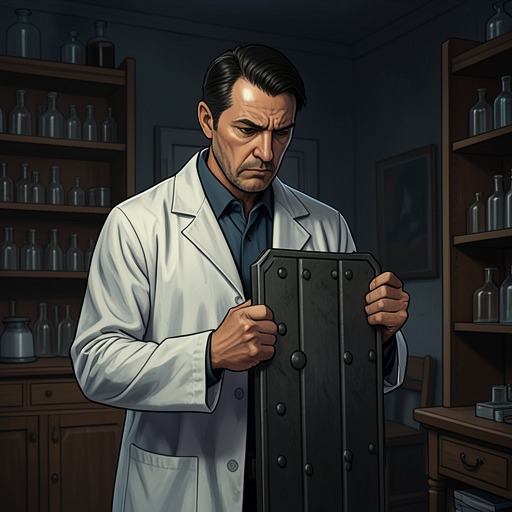
At the Newberry Library, the building’s spaces acquire a different kind of threat. Henry describes fearing the stairwell and its four-story steel Cage, a structure at the center of the stairs whose purpose is unclear to him. On June 28, 2006, he comes to inside the Cage after hours, disoriented and unable to know how long he must wait. He anticipates that his coworkers will see him and learn about the condition he has been trying to keep from them. The episode turns a familiar workplace into the site of involuntary disclosure: he waits there for hours, cold and uncertain, rehearsing what he might say.
The later effects of bodily injury and confinement also shape the household’s routines. After Henry has lost his feet, he tells Kimy that he cannot get out of bed; she insists that he use his wheelchair and helps him toward a bathroom too narrow for the chair to enter. In the kitchen, he cannot reach the counters and cabinets from his wheelchair, so he teaches Clare to cook from the table, passing her a cutting board and knife. They make meals and desserts together, and Clare eventually cooks dinner on her own for Henry and Alba. The condition’s consequences are not limited to the instant of departure: they reorganize domestic space, require care, and also generate forms of shared work.
Narrative Significance
Henry’s condition makes time a lived mismatch between bodies rather than a single common sequence. The paired dates and differing ages attached to episodes ask the reader to track not only when an event occurs, but who has reached it, who remembers it, and what each person can know. Clare’s first encounter with Henry is not necessarily his first experience of her; an event can arrive as a beginning for one and as a return for the other. The resulting structure lets anticipation, memory, and reunion occupy the same relationship without making their experiences interchangeable.
The disorder also binds extraordinary temporal movement to practical vulnerability. Henry’s involuntary arrivals may take him into moments of importance, but they also expose him to arrest, workplace discovery, and dependence on other people. In the family scenes, assistance and adaptation answer some of the constraints without curing or controlling them: Clare learns to cook in a kitchen Henry cannot use in the ordinary way, while Kimy helps him navigate daily care. The condition’s significance lies in this double pressure. It makes connection across time possible, yet repeatedly interrupts the shared present on which a life together depends.